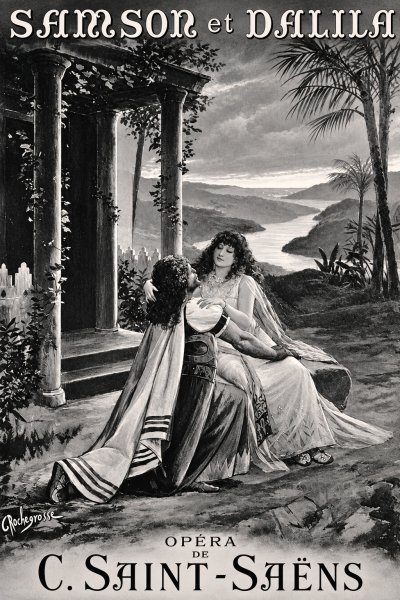
 A new composer has been added to LibrettoArchive: Camille Saint-Saëns, beginning with his best-known opera, Samson et Dalila (Samson and Delilah).
The complete libretto by Ferdinand Lemaire is now available in French, German, and English, with side-by-side versions for reading and comparison.
Samson et Dalila is one of the best-known French operas of the nineteenth century. Saint-Saëns began working on it in the late 1860s, and the opera received its world premiere in Weimar on December 2, 1877.
The story is based on the biblical account of Samson and Delilah from the Book of Judges. Samson leads the Hebrews against the Philistines, but his love for Delilah eventually leads to his betrayal, capture, and blindness. In the final scene, he regains his strength and destroys the temple of Dagon.
The opera includes some of Saint-Saëns’s most famous music, especially Delilah’s arias “Printemps qui commence” and “Mon cœur s’ouvre à ta voix,” as well as the Act III Bacchanale.
While preparing the French–English side-by-side text, I went through the libretto closely and corrected a number of errors, inconsistencies, and places where the English did not fully match the French.
One of the more important examples occurs in Act II, when Samson tells Delilah:
Crains que je ne doute de toi !
The previous English text gave essentially the opposite meaning. It has now been corrected to:
“Beware lest I come to doubt you!”
There were many smaller details as well. Dalila adorns herself with troène — privet, not myrtle. At the end of Act II she appears à sa fenêtre — at her window, not on a terrace. In the final temple scene, the French specifies two marble columns, an important detail that had been omitted from the English text.
Character names, stage directions, repeated passages, punctuation, and line-by-line alignment were also reviewed so that the languages can be followed more easily side by side.
The French–English paperback is now available on Amazon as part of DM’s Opera Series:
Amazon paperback:
https://amzn.to/4yF02l1
PDF sample is also available:
https://librettoarchive-media.s3.amazonaws.com/pdf/samson-and-delilah-side-by-side-french-english-opera-libretto_sample.pdf
Samson et Dalila works particularly well in a side-by-side format. The opera moves between large biblical choruses and much more intimate scenes between Samson and Dalila, and following the original French alongside another language makes many details of the drama easier to notice.

0 comments
No comments yet. Be the first!
Leave a comment