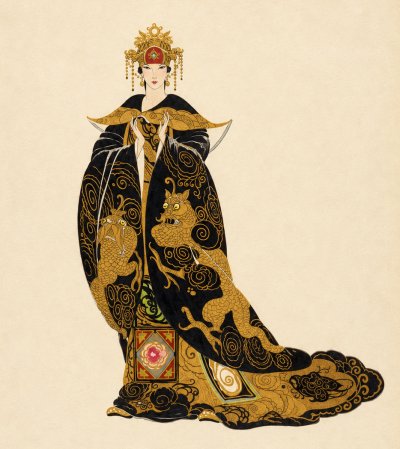
 I've completed an editorial review of Giacomo Puccini's Turandot, with a libretto by Giuseppe Adami and Renato Simoni.
The Italian–English side-by-side text has been available on LibrettoArchive for some time. I returned to it to correct transcription and translation errors, compare several passages with published Italian libretti, and improve the presentation of the text. During this review, I also discovered missing material in Act II that needed to be restored.
The updated text is available on the website, and I have prepared a revised second edition of the paperback. The work described here concerns the Italian–English version; Turandot is also available on LibrettoArchive in other language combinations.
Read the libretto and explore the book
- Read the Italian–English side-by-side libretto
- Read the Italian–German side-by-side libretto
- Read the Italian–French side-by-side libretto
- Paperback edition on Amazon
- Preview the book (PDF)
Revisiting the Italian Text and English Translation
Much of the review involved correcting relatively small errors. Some came from optical character recognition (OCR), where letters had been mistaken for one another. For example, Il lavoro had appeared as II lavoro, with two capital I's replacing the Italian article. Another error occurred in the opening stage direction, where palazzo (“palace”) appeared instead of piazzale (“square”). The corresponding English passage already described the palace yard correctly.
Other corrections required a closer reading of the dialogue. In Act I, Liù pleads with Calaf to abandon his dangerous pursuit of Turandot. Her words, Se questo suo strazio non basta, had been rendered in English as though she were referring to the suffering of the person she addresses. The Italian instead refers to Timur's anguish. Correcting the translation restores an important distinction in Liù's appeal.
Not every unusual form should be treated as an error. Timur's Ed io cadeva affranto preserves an older first-person imperfect form. Although cadevo is more familiar to modern readers, cadeva is a legitimate historical reading. Editorial revision sometimes means preserving a form rather than correcting it.
Restoring Missing Passages in Act II
The most substantial discovery came during the scene involving Ping, Pang, and Pong.
In this scene, the three ministers, weary of preparing executions, imagine what might happen if Turandot finally marries. Their conversation gradually becomes a playful vision of the wedding night.
Comparison with published libretti revealed that parts of this sequence were missing from the existing text. Among them were the invocation O tigre! O tigre!, preparations for the bridal chamber, and passages describing a yellow silk coverlet, whispered words of love, and flowers covered with dew.
I restored the missing Italian lines and their English counterparts, paying particular attention to the individual parts of Ping, Pang, and Pong. Their voices frequently alternate and overlap, and the speaker labels are important for understanding the theatrical character of the scene.
One correction was especially revealing. The Italian had read già sei donna (“you are already a woman”), but the correct reading is già sei doma (“you are already subdued”). The difference changes the meaning: the ministers are imagining not simply Turandot's marriage, but the defeat of her resistance to love.
Improving the Side-by-Side Text and Paperback
I also reviewed character labels, stage directions, punctuation, and consistency between the two languages. Some English passages needed corrections to reflect the Italian more accurately, while others benefited from clearer wording.
In the paperback, I removed unnecessary manual line breaks from longer stage directions. These had created awkward wrapping and sometimes disturbed the alignment of the two columns. The sung lines remain arranged separately, preserving the structure of the libretto.
The revised paperback is the second edition of Turandot in DM's Opera Series. It incorporates the corrected texts, restored passages, and formatting improvements.
Returning to an existing libretto often reveals details that were easy to overlook during its first preparation. In Turandot, the restored ministers' scene is a particularly interesting example: a few missing lines and one incorrect word had diminished both the humor of the passage and its underlying meaning.
For Readers Who Purchased the Earlier Edition
If you purchased the previous paperback edition of Turandot, I would be happy to send you a free copy of the revised second edition.
I appreciate your support of LibrettoArchive and want readers who already own the book to benefit from the corrections and restored passages.
Please contact me through LibrettoArchive to request your replacement copy.
— Dmitrii Murashev

0 comments
No comments yet. Be the first!
Leave a comment