| Camille Saint-Saëns operas |
|
• Samson et Dalila (1877) |
“Samson et Dalila” by Camille Saint-Saëns
♡
Read Samson et Dalila with the original libretto and a clear English translation presented side by side.
See on Amazon – $11.99 → 📄 Preview sample (PDF)Premiere / date of written: 2 December 1877
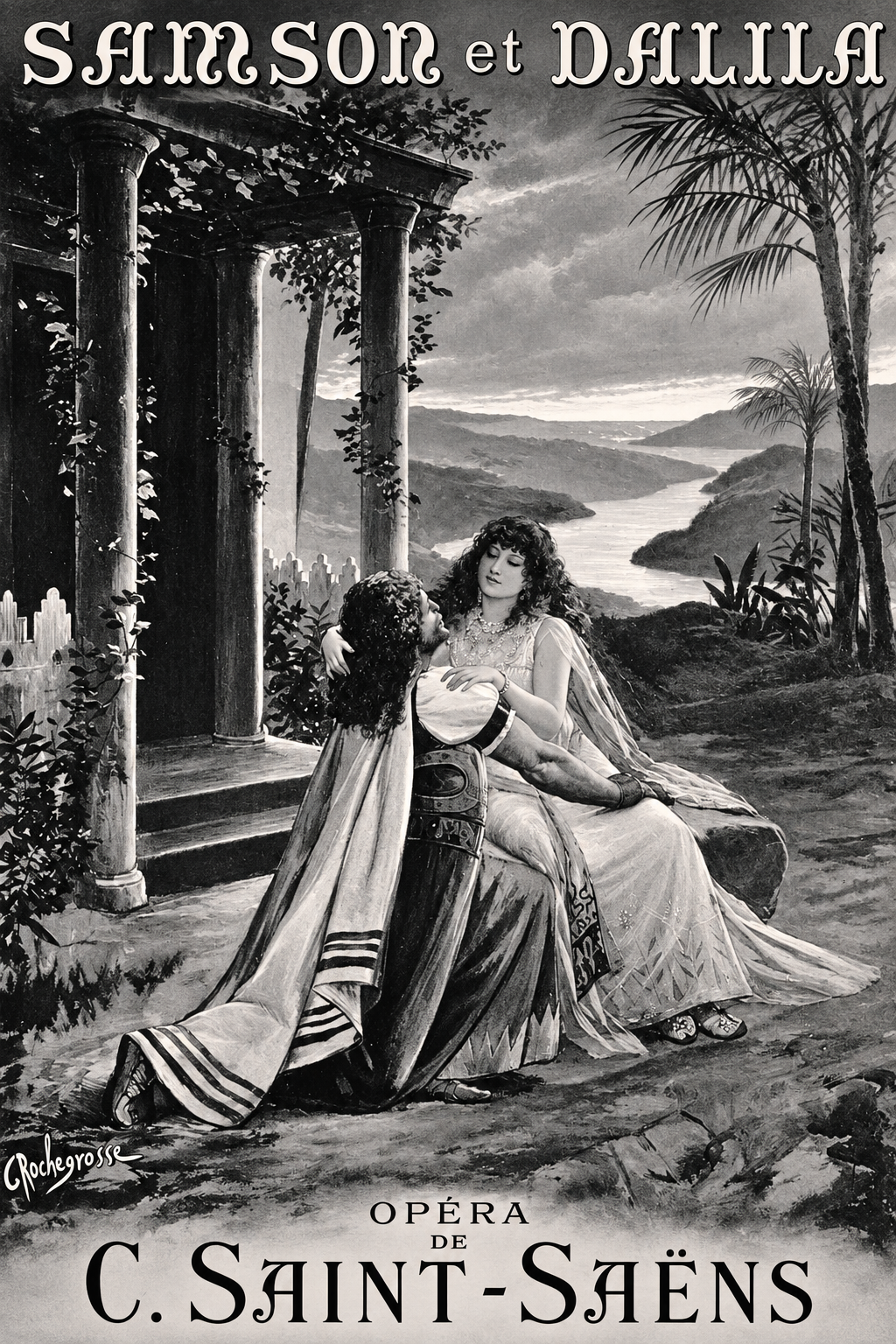
Samson and Delilah (Samson et Dalila) is an opera in three acts by Camille Saint-Saëns, with a French libretto by Ferdinand Lemaire. The story is based on the biblical account of Samson in the Book of Judges.
The opera is set in Gaza, where the Hebrews are under Philistine rule. Samson leads his people in revolt, but Delilah, a Philistine woman, persuades him to reveal the secret of his strength. She betrays him, and Samson is captured, blinded, and imprisoned. In the final act, he regains his strength and destroys the temple of Dagon, killing himself and many of the Philistines.
Saint-Saëns began work on the opera in the late 1860s. It was first performed in Weimar on December 2, 1877, in a German translation. The opera later became the best known of Saint-Saëns’s stage works.
Among its best-known numbers are Delilah’s arias “Printemps qui commence” and “Mon cœur s’ouvre à ta voix,” and the “Bacchanale” in Act III.
Libretti
French–English side-by-side translation
| # | Language | Authors |
|---|---|---|
| 1 |
French
  |
Ferdinand Lemaire |
| 2 |
German
|
Gudrun Meier |
| 3 |
English
|
original libretto
side-by-side of the original libretto
Notes on the Libretto
Close comparison of the French and English texts reveals several small differences with surprisingly large consequences. In Act II, when Dalila presses Samson to reveal his secret, he answers, “Crains que je ne doute de toi !” The construction craindre que... ne is easily misunderstood: the English text had “Have no fear that I distrust you,” which reverses the sense. Samson is in fact warning her: “Beware lest I come to doubt you!” At this point suspicion has already entered a scene otherwise governed by desire and persuasion.
Other corrections restore details that had disappeared or shifted in translation. In Act I, Dalila adorns herself with des grappes noires du troène—dark clusters of privet, not myrtle. Stage directions proved equally revealing. At the end of Act II, Dalila appears à sa fenêtre, “at her window,” rather than on a terrace; and in the temple scene the French specifies deux colonnes de marbre, “two marble columns,” an important visual detail in view of Samson’s final act.
Preparing the side-by-side text also required restoring several omitted stage directions and maintaining distinctions that can easily vanish when the two languages are aligned line by line.
Images
Printed Editions
| Year | Edition | Publisher | Buy |
|---|---|---|---|
| 2026 | Samson and Delilah: Side-by-Side French–English Opera Libretto | DM’s Opera Series |
|
Video recordings
| Year | Cast | Conductor, Opera chorus and orchestra, Director |
Label, Comment |
Buy |
|---|---|---|---|---|
| 1998 | Samson — Plácido Domingo Dalila — Olga Borodina Grand-prêtre de Dagon — Sergei Leiferkus Abimélech — Richard Paul Fink Un vieillard hébreu — René Pape Un messager philistin — Charles Anthony Premier Philistin — Bernard Fitch Deuxième Philistin — Alfred Walker |
James Levine Metropolitan Opera Orchestra, Chorus and Ballet |
Deutsche Grammophon |

|
Related links
- Samson et Dalila by Camille Saint-Saëns in French, German, and English — LibrettoArchive Blog
- Wikipedia, the free encyclopedia
- Recordings of Samson and Delilah on operadis-opera-discography.org.uk 65 recordings of Samson et Dalila by Camille Saint-Saens from 1936 to 2009