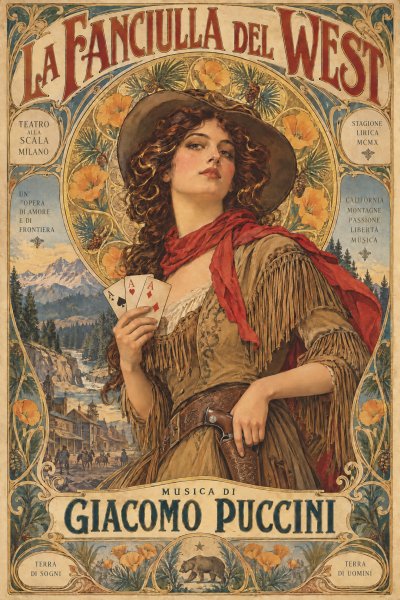
 I've completed a new English translation of Giacomo Puccini's La fanciulla del West (The Girl of the Golden West), with a libretto by Guelfo Civinini and Carlo Zangarini, based on David Belasco's play.
The work involved much more than translating the dialogue. I also reviewed the original Italian text, corrected transcription errors, reconsidered several expressions, and carefully aligned the two languages for side-by-side reading.
La fanciulla del West was first performed at the Metropolitan Opera in New York on December 10, 1910, with Emmy Destinn as Minnie, Enrico Caruso as Dick Johnson, and Arturo Toscanini conducting. Its California Gold Rush setting gives the libretto a distinctive character, with a mixture of Italian operatic poetry, American expressions, and the rough language of frontier life.
Read the Libretto and Explore the Book
An Italian–Russian version is also available on LibrettoArchive.
Revisiting the Italian Text
While preparing the new translation, I went through the Italian libretto to identify errors introduced during transcription and formatting.
Some were straightforward: malformed punctuation, incorrect character names, misplaced quotation marks, and occasional words damaged by OCR. Other passages required more care, especially where punctuation or an unusual expression could affect the meaning.
I generally preserved the historical language rather than modernizing it. Forms such as giuoco, colla, and spagnuolo belong naturally to the period text. The aim was to correct mistakes without removing the character of the original.
The stage directions also received close attention. They are particularly detailed in this opera, describing the movement of crowds, the changing atmosphere of the mining camp, and the actions of individual characters. Keeping these directions complete was an important part of the work.
A New English Translation
One challenge was finding natural English expressions without losing connections between different passages.
An example appears when Minnie hears that a stranger has asked for whiskey and water. She replies:
“Bene, venga. Gli aggiusteremo i ricci.”
Later, Johnson enters the saloon and asks:
“Chi c'è, per farmi i ricci?”
The two lines form a small joke. In English, they now read:
“All right, come along. We'll fix his curls.”
“Who's going to fix my curls?”
The repetition matters. Translating Minnie's first remark simply as “We'll set him straight” would make Johnson's response seem rather puzzling.
Other passages needed clarification or more complete translation. Particular attention was given to the exchanges between Minnie and Johnson, the miners' accusations, and the lengthy final scene, where changes in tone and individual reactions are essential to the drama.
The Final Act and the Theme of Redemption
One of the most interesting discoveries during this work was how closely the ending recalls Minnie's Bible lesson in Act I.
Early in the opera, she teaches the miners that no sinner is beyond redemption:
“Non v'è, al mondo, peccatore cui non s'apra una via di redenzione...”
In Act III, when Johnson faces execution, Minnie returns to almost the same words. What began as a lesson becomes her final argument for saving the man she loves.
This connection is central to the opera's dramatic structure. The miners ultimately act upon the principle Minnie taught them, even though forgiving Johnson means losing her.
The new Italian–English text preserves these verbal connections, the complete stage directions, and the individual voices of the characters. My aim was to make the libretto easier to follow while remaining attentive to the language and dramatic intentions of the original.
— Dmitrii Murashev

0 comments
No comments yet. Be the first!
Leave a comment