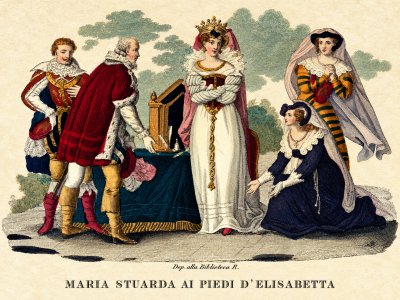
 I've completed a new Italian–English bilingual libretto of Gaetano Donizetti's Maria Stuarda, with a libretto by Giuseppe Bardari based on Friedrich Schiller's tragedy.
The work involved preparing the English translation, reviewing the Italian text, correcting transcription errors, and aligning both languages line by line. The new paperback, Maria Stuarda: Side-by-Side Italian–English Opera Libretto, is now published and available on Amazon.
Donizetti's opera is particularly interesting from an editorial perspective. Its history involves censorship, revisions, and differences between printed and performed texts. Some of these questions emerged while I was preparing the libretto.
Explore the libretto and book:
Revisiting the Italian Text
One of the most useful parts of preparing this libretto was comparing the Italian text with other published sources and, occasionally, listening to recordings to resolve doubtful passages.
An interesting example occurs in Maria's confession scene. Talbot asks:
Che favelli? — “What are you saying?”
However, the printed text accompanying one recording gives Che favello?, meaning “What am I saying?”
Both expressions are grammatically possible, but they have different meanings. In this case, the dramatic context favors Che favelli?, and listening to the recording confirmed that this was what the singer actually sang.
Another correction concerned Maria's words to the spirit of her dead husband:
Ti bastin le mie lagrime,
Ti basti il mio tormento.
One transcription gave Ei basti in the second line, which did not fit the intended meaning. Comparing the passage with other sources established the correct reading: Maria asks that her tears and suffering be accepted as sufficient atonement.
These are small differences on the page, but they matter when presenting the Italian and English texts together.
A Libretto with a Complicated History
Maria Stuarda was originally intended for Naples in 1834, but the planned production was prohibited. Donizetti's music was subsequently adapted for another opera, Buondelmonte. Maria Stuarda finally received its premiere at La Scala in Milan on December 30, 1835, with Maria Malibran in the title role.
The confrontation between Maria and Elisabetta was especially controversial. Maria's famous insult, “vil bastarda” (“vile bastard”), was softened by the Milanese censors, but Malibran reportedly restored the original words in performance.
This history is worth remembering when comparing librettos. Differences between printed texts do not always result from copying mistakes; sometimes they reflect censorship, revisions, or the circumstances of a particular production.
Preparing the Side-by-Side Edition
The English translation follows the Italian line by line, allowing readers to move easily between the two languages while following the dialogue and musical numbers.
I also reviewed character names, stage directions, historical terminology, and punctuation. For example, Cecil's office is identified as gran tesoriere, properly rendered as “Lord High Treasurer,” rather than “Chancellor of the Exchequer.”
At the same time, I have preserved authentic poetic Italian wherever possible. Forms such as soglio, Imene, and ritorte belong to the language of the libretto and should not be treated as errors simply because they are unfamiliar today.
The new paperback, Maria Stuarda: Side-by-Side Italian–English Opera Libretto, is now available on Amazon. It presents the complete Italian and English texts side by side, incorporating the corrections and editorial decisions made during preparation.
Working on Maria Stuarda reminded me that even a familiar opera can raise unexpected textual questions. Sometimes resolving a single word means returning to historical sources, considering the dramatic context, or simply listening carefully to what is actually sung.
— Dmitrii Murashev

0 comments
No comments yet. Be the first!
Leave a comment