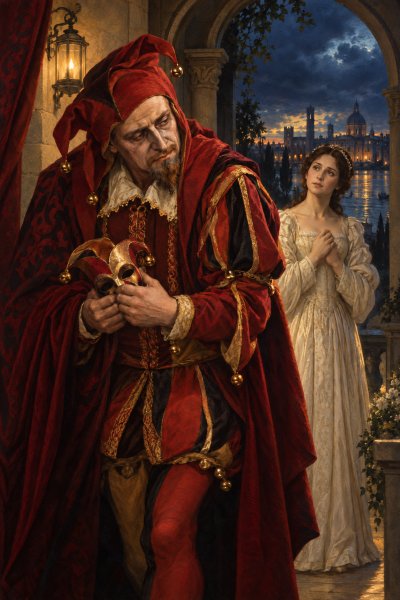
 I've completed a careful revision of Giuseppe Verdi's Rigoletto, with a libretto by Francesco Maria Piave. The work involved reviewing the Italian and English texts, correcting translation errors, restoring a short missing passage, and improving the consistency of the side-by-side presentation.
Rigoletto has a special place in the history of LibrettoArchive. It was the second opera I added to the collection when I started the project in 2012, and later became my eighth book published on Amazon. After so many years, I decided to revisit the text more carefully. That closer examination revealed several problems worth correcting. Some were ordinary transcription errors, while others affected the meaning of the words or the alignment of the Italian and English texts.
Read Rigoletto
- Read the Italian–English side-by-side libretto
- Read the Italian–German side-by-side libretto
- Read the Italian–French side-by-side libretto
- Paperback edition on Amazon
- Preview the book (PDF)
Restoring Gilda's Missing Lines
One of the more interesting discoveries came while checking the famous Act Three quartet, Bella figlia dell'amore.
In the text I was working with, Gilda's lament contained only these two lines:
Infelice cor tradito,
per angoscia non scoppiar.
The English translation reads:
O wretched, betrayed heart,
do not break with grief!
However, comparison with other published Italian librettos, including the text used by Teatro La Fenice, revealed two additional lines:
Perché, o credulo mio core,
un tal uom dovevi amar!
Or, in English:
Why, my trusting heart,
did you have to love such a man?
These lines are important because they complete Gilda's thought. She is not simply grieving over the Duke's betrayal. She is asking herself why she trusted and loved him in the first place.
The missing lines have now been restored in the Italian–English text. Later abbreviated repetitions remain as they appear in the libretto.
Correcting a Famous Aria
Another significant correction concerned La donna è mobile, probably the best-known number in Rigoletto.
The Italian words:
muta d'accento
e di pensier
had previously been translated as:
simple in speech
and simple in mind.
This is incorrect. The Italian verb mutare means to change. The Duke is describing a woman whose words and thoughts are constantly changing, not someone who is simple-minded.
The revised English reads:
changing her tone
and her mind.
I also corrected the interrupted repetition of the aria later in Act Three, when the Duke begins singing again before falling asleep. Both passages now follow the same wording.
It is a small change in the number of words, but quite an important one in meaning.
Names, Stage Directions, and Text Alignment
Several other corrections emerged during proofreading.
The Duke introduces himself to Gilda under the false name Gualtier Maldè. In the English text, this had appeared as Walter Maldè. I decided to preserve the original name throughout, particularly because Gilda repeats it in her aria Caro nome.
Some stage directions also needed attention. For example, the Italian Le prende la mano means that the Duke takes Maddalena's hand, rather than caressing it. Near the opera's conclusion, the English description of Rigoletto collapsing over his daughter's body was adjusted to avoid suggesting an action not explicitly stated in the Italian.
I also corrected various misprints, inconsistent speaker labels, punctuation, and passages where missing or incorrectly divided lines caused the Italian and English columns to fall out of alignment.
This last point is especially important in a side-by-side libretto. When following an opera with a recording, readers should be able to move easily between the original words and their English equivalents without losing their place.
The Second Paperback Edition
All these corrections have been incorporated into the second edition of Rigoletto in DM's Opera Series, available through Amazon.
The book retains the familiar Italian–English side-by-side format, but the text has been revised and the layout checked again. Readers can now follow the opera with a more consistent and accurate presentation of Piave's words.
For Readers Who Purchased the Earlier Edition
If you purchased the first edition of my Rigoletto paperback, I would be happy to send you a free copy of the updated second edition.
I appreciate everyone who has supported my work, and I want previous readers to have access to the corrected text as well.
Simply contact me through the LibrettoArchive contact form and mention that you purchased the earlier edition of Rigoletto. I'll be happy to arrange a replacement.
A Few Final Thoughts
Working through Rigoletto again reminded me how much can depend on a single word or a seemingly insignificant omission.
The restoration of Gilda's lines and the correction of La donna è mobile are perhaps the best examples. Neither changes the familiar story, but both bring the English text closer to what Piave actually wrote.
That is the purpose of these revisions: to make the libretti more reliable, more consistent, and easier to follow while preserving the character of the original.
— Dmitrii Murashev