“Turandot” by Giacomo Puccini
♡
This second updated edition.
See on Amazon → 📄 Preview sample (PDF)Premiere / date of written: 25 April 1926
Turandot is an opera in three acts by Giacomo Puccini, with an Italian libretto by Giuseppe Adami and Renato Simoni, based on Carlo Gozzi’s play of the same name. Set in imperial China, the opera tells the story of Princess Turandot, whose suitors must solve three riddles or face execution.
Puccini died in 1924 before completing the opera. Franco Alfano subsequently finished the final scenes using Puccini’s sketches. Turandot premiered at the Teatro alla Scala in Milan on April 25, 1926, conducted by Arturo Toscanini.
Libretti
Italian–English side-by-side translation
| # | Language | Authors |
|---|---|---|
| 1 |
Italian
  |
Giuseppe Adami, Renato Simoni. |
| 2 |
German
|
|
| 3 |
English
|
|
| 4 |
French
|
|
| 5 | Russian |
original libretto
side-by-side of the original libretto
Notes on the Libretto
A careful editorial review of the existing Italian–English text of Turandot revealed several errors in transcription and translation. In the opening stage direction, palazzo (“palace”) had replaced piazzale (“square”), although the English text correctly described the palace yard. Elsewhere, optical character recognition had confused the letters Il with II, producing such readings as II lavoro and II vasto piazzale.
Not every unusual form, however, is an error. Timur’s Ed io cadeva affranto preserves an archaic first-person imperfect form. Modernizing cadeva to cadevo would make the grammar more familiar, but would also discard a legitimate historical reading.
Comparison of the Italian and English also exposed a more consequential mistake in Liù’s plea, Se questo suo strazio non basta. The possessive refers to Timur’s suffering, whereas an earlier English rendering mistakenly attributed the anguish to the person being addressed. A small grammatical distinction thus changes the emotional meaning of the passage.
A more substantial discovery concerned the ministers’ imagined celebration of Turandot’s marriage in Act II. Comparison with published libretti revealed missing passages describing the bridal chamber, a yellow silk coverlet, and a garden filled with whispered words of love. Restoring these lines also required attention to the interwoven voices of Ping, Pang, and Pong. Particularly revealing was the correction of già sei donna (“you are already a woman”) to già sei doma (“you are already subdued”), restoring the ministers’ expectation that Turandot’s proud resistance will finally be overcome.
History
| November 16, 1926 | U.S. (and Metropolitan Opera) premiere of Puccini's 'Turandot' in New York, conducted by Tullio Serafin with Maria Jeritza and Giacomo Lauri-Volpi. |
| May 4, 2025 | Lyric Opera of Kansas City stages Puccini's 'Turandot' at the Kauffman Center for the Performing Arts. |
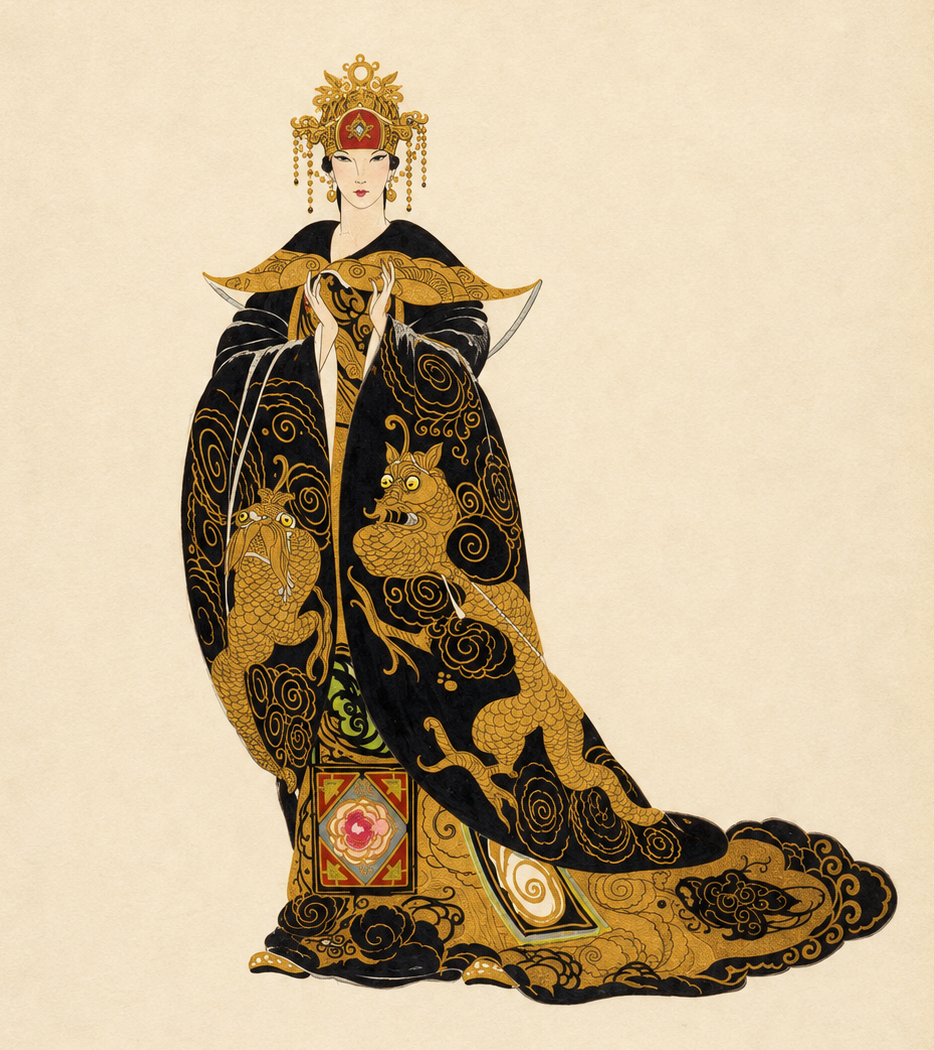
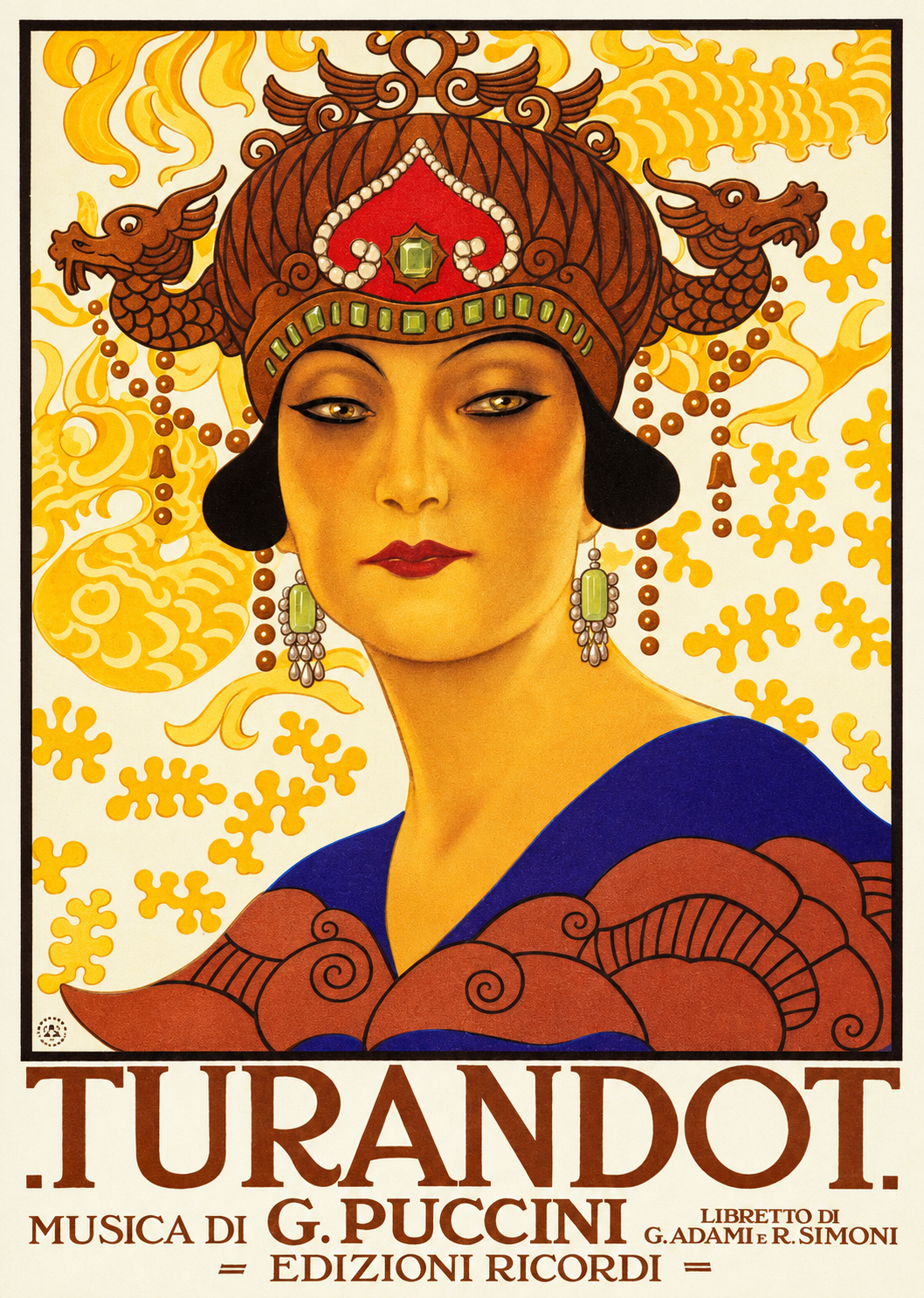
Images
Printed Editions
| Year | Edition | Publisher | Buy |
|---|---|---|---|
| 2024 | Turandot: Opera Libretto with Italian–English Translation | DM’s Opera Series |
|
Audio recordings
| Year | Cast | Conductor, Opera chorus and orchestra |
Label, Comment |
Buy |
|---|---|---|---|---|
| 1957 | Turandot — Maria Callas, Calaf — Eugenio Fernandi, Liù — Elisabeth Schwarzkopf, Timur — Nicola Zaccaria |
Tullio Serafin La Scala Orchestra and Chorus |
Audio CD: EMI Classics Cat: 56307 |

$15.13 |
| 1965
|
Turandot — Birgit Nilsson, Calaf — Franco Corelli, Liù — Renata Scotto, Timur — Bonaldo Giaiotti |
Francesco Molinari-Pradelli Rome Opera House Orchestra, Rome Opera House Chorus |
Audio CD: EMI Classics Cat: 077776932729 |

$8.29 |
| 1972 | Turandot — Joan Sutherland, Calaf — Luciano Pavarotti, Liù — Montserrat Caballé, Timur — Nicolai Ghiaurov |
Zubin Mehta London Philharmonic Orchestra, John Alldis Choir, Wandsworth School Boys' Chorus |
Audio CD: Decca Cat: 414274 |

$35.46 |
| 1977 | Turandot — Montserrat Caballé, Calaf — José Carreras, Liù — Mirella Freni, Timur — Paul Plishka |
Alain Lombard Strasbourg Philharmonic Orchestra, Rhine Opera Chorus, Maitrise de la Cathedrale de Strasbourg |
Audio CD: EMI Classics Cat: 65293 |

$17.69 |
| 1981 | Turandot — Katia Ricciarelli, Calaf — Plácido Domingo, Liù — Barbara Hendricks, Timur — Ruggero Raimondi |
Herbert von Karajan Vienna State Opera Chorus and Orchestra, Vienna Sängerknaben |
Audio CD: Deutsche Grammophon Cat: 423855 |

$9.99 |

Video recordings
| Year | Cast | Conductor, Opera chorus and orchestra, Director |
Label, Comment |
Buy |
|---|---|---|---|---|
| 1988
|
Turandot — Eva Marton, Calaf — Plácido Domingo, Liù — Leona Mitchell, Timur — Paul Plishka |
James Levine Metropolitan Opera orchestra and chorus Franco Zeffirelli |
DVD: Deutsche Grammophon Cat: 00440 073 0589 |

$23.00 |
| 2009 | Turandot — Maria Guleghina,, Calaf — Marcello Giordani, Liù — Marina Poplavskaya, Timur — Samuel Ramey |
Andris Nelsons Metropolitan Opera orchestra, chorus and ballet Franco Zeffirelli |
Decca |

$57.99 |
Related links
- Turandot: Italian–English Side-by-Side Libretto With Translation — LibrettoArchive Blog
- Wikipedia, the free encyclopedia