| Giuseppe Verdi operas |
|
• Macbeth (1847) • Rigoletto (1851) • Il trovatore (1853) • La traviata (1853) • Les vêpres siciliennes (1855) • Un ballo in maschera (1859) • La forza del destino (1862) • Aida (1871) • Otello (1887) • Falstaff (1893) |
“Aida” by Giuseppe Verdi
♡
Read Aida with the original libretto and a clear English translation presented side by side.
See on Amazon – $11.99 → 📄 Preview sample (PDF)Premiere / date of written: 24 December 1871
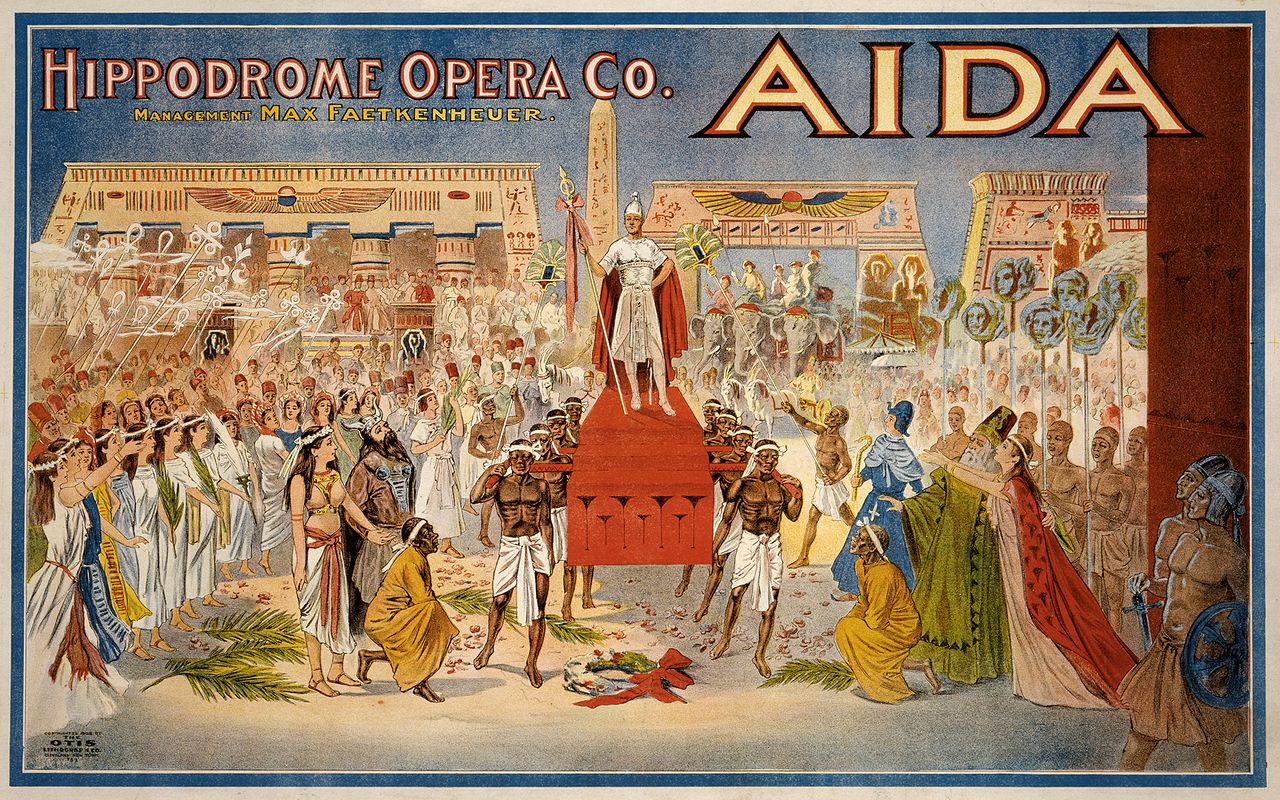
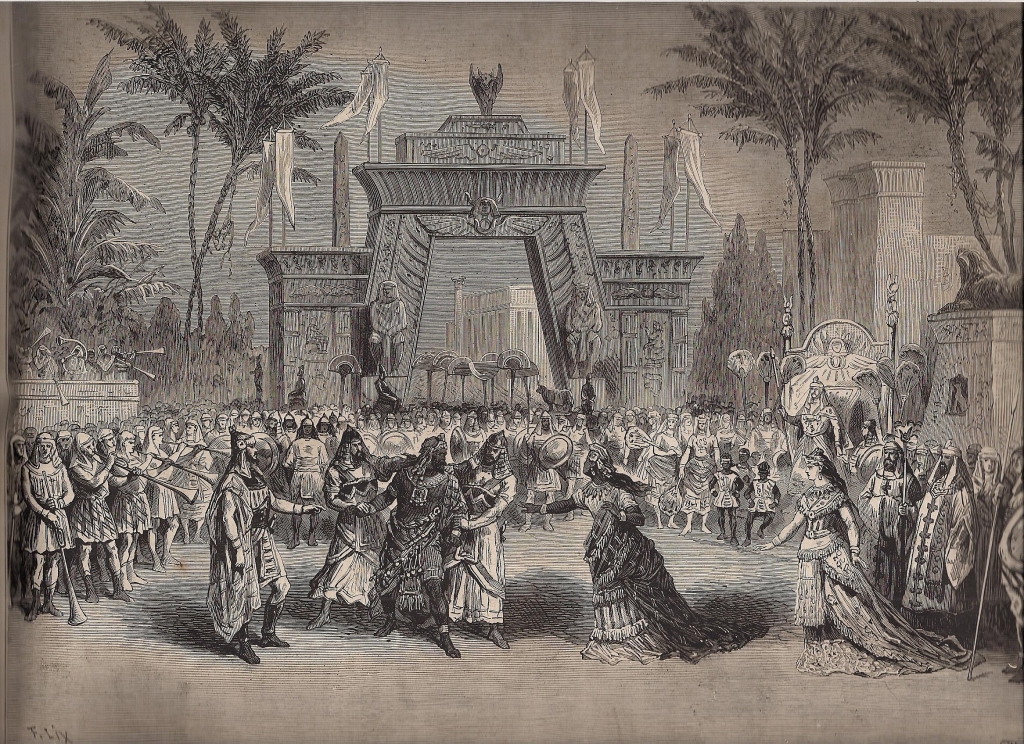
Aida is an opera in four acts by Giuseppe Verdi, with a libretto by Antonio Ghislanzoni. Set in ancient Egypt, the opera centers on the conflict between love, loyalty, and duty as the Egyptian commander Radamès falls in love with Aida, an Ethiopian princess held captive in Egypt. It was first performed at the Khedivial Opera House in Cairo on December 24, 1871, conducted by Giovanni Bottesini. With its grand ceremonial scenes and intimate personal drama, Aida remains one of Verdi’s most frequently performed operas.
Libretti
Italian–English side-by-side translation
| # | Language | Authors |
|---|---|---|
| 1 |
Italian
  |
Antonio Ghislanzoni |
| 2 | German | |
| 3 |
English
|
|
| 4 | French |
original libretto
side-by-side of the original libretto
Notes on the Libretto
Aida began not with Ghislanzoni’s verses but with a prose scenario associated with the French Egyptologist Auguste Mariette and developed with Camille du Locle. Antonio Ghislanzoni subsequently fashioned the Italian libretto in close consultation with Verdi. The opera was commissioned for Cairo and received its first performance there on 24 December 1871; contrary to a persistent legend, it was not composed for the opening of the Suez Canal.
Verdi’s concern with the force of individual words is especially evident in “Ritorna vincitor!”—“Return victorious!”—the cry that precipitates Aida’s great Act I monologue. In correspondence concerning Aida, Verdi used the expression parola scenica for language possessing an immediate theatrical power; the Metropolitan Opera notes “Ritorna vincitor!” as a characteristic example. The phrase is perfectly simple grammatically, yet dramatically cruel: Aida realizes that in wishing Radamès victorious she has wished defeat upon her father and her own people.
Preparing the Italian–English text also exposed smaller inconsistencies that easily pass unnoticed. The female religious figure in the Temple of Vulcan is simply Sacerdotessa. “Priestess” has therefore been retained rather than the sometimes encountered “High Priestess”; the Italian supplies no suprema or other indication of superior rank. Historical Met records likewise list the role simply as “Priestess.”
Even the Egyptian setting calls for some editorial restraint: Ghislanzoni specifies only ancient Egypt “in the time of the Pharaohs,” leaving the drama deliberately outside a precise historical reign.
History
| December 24, 1871 | Giuseppe Verdi’s opera "Aida" had its world premiere at the Opera House in Cairo. |
| February 8, 1872 | European premiere of Verdi’s "Aida" at La Scala (Milan). |
Images

Printed Editions
| Year | Edition | Publisher | Buy |
|---|---|---|---|
| 2025 | Aida: Opera Libretto with Italian–English Translation | DM’s Opera Series |
|
Audio recordings
| Year | Cast | Conductor, Opera chorus and orchestra |
Label, Comment |
Buy |
|---|---|---|---|---|
| 1951 | Aida — Maria Callas, Amneris — Oralia Domínguez, Radames — Mario Del Monaco, Amonasro — Giuseppe Taddei, Ramfis — Roberto Silva |
Oliviero De Fabritiis Palacio de Bellas Artes Orchestra and Chorus, Mexico City |
CD: EMI Classics Cat: 62678 |

$93.95 |
| 1962 | Aida — Leontyne Price, Amneris — Rita Gorr, Radames — Jon Vickers, Amonasro — Robert Merrill, Ramfis — Giorgio Tozzi |
Sir Georg Solti Rome Opera House Orchestra and Chorus |
CD: Decca Cat: 4607652 |

$18.40 |
| 1974 | Aida — Montserrat Caballé, Amneris — Fiorenza Cossotto, Radames — Plácido Domingo, Amonasro — Piero Cappuccilli, Ramfis — Nicolai Ghiaurov |
Riccardo Muti New Philharmonia Orchestra and the Royal Opera House Covent Garden Chorus |
CD: EMI Classics Cat: 5676132 |

$11.60 |
| 1979 | Aida — Mirella Freni, Amneris — Agnes Baltsa, Radames — José Carreras, Amonasro — Piero Cappuccilli, Ramfis — Ruggero Raimondi |
Herbert von Karajan Vienna Philharmonic and the Vienna State Opera Chorus |
CD: EMI Classics Cat: 81877 |

$29.38 |
| 1986 | Aida — Maria Chiara, Amneris — Ghena Dimitrova, Radames — Luciano Pavarotti, Amonasro — Leo Nucci, Ramfis — Paata Burchuladze |
Lorin Maazel La Scala Orchestra and Chorus, Milan |
CD: Decca Cat: 417439 |

$19.49 |
| 1991 | Aida — Aprile Millo, Amneris — Dolora Zajick, Radames — Plácido Domingo, Amonasro — James Morris, Ramfis — Samuel Ramey |
James Levine Metropolitan Opera Orchestra and Chorus and Ballet |
CD: Sony Cat: 88697527722 |

$21.88 |
| 2015 | Aida — Anja Harteros, Amneris — Ekaterina Semenchuk, Radames — Jonas Kaufmann, Amonasro — Ludovic Tézier, Ramfis — Erwin Schrott, Il Re d'Egitto — Marco Spotti, Messaggero — Paolo Fanale, Sacerdotessa — Eleonora Buratto |
Sir Antonio Pappano Orchestra and Chorus of the Accademia di Santa Cecilia, Rome |
Rhino Warner Classics |

$44.99 |
Video recordings
| Year | Cast | Conductor, Opera chorus and orchestra, Director |
Label, Comment |
Buy |
|---|---|---|---|---|
| 1966 | Aida — Leyla Gencer, Amneris — Fiorenza Cossotto, Radames — Carlo Bergonzi, Amonasro — Anselmo Colzani, Ramfis — Bonaldo Giaiotti |
Arena di Verona orchestra and chorus and the Corps de Ballet of the Kirov Theatre |
Hardy Classic Cat: HCD 4010 |

$19.96 |
| 1981 | Aida — Margaret Price, Amneris — Stefania Toczyska, Radames — Luciano Pavarotti, Amonasro — Simon Estes, Ramfis — Kurt Rydl |
Garcia Navarro War Memorial Opera House (San Francisco) orchestra and chorus Sam Wanamaker |
Kultur International Films Cat: 3984 22366 2 |
$38.00 |
| 1986 | Aida — Maria Chiara, Amneris — Ghena Dimitrova, Radames — Luciano Pavarotti, Amonasro — Juan Pons, Ramfis — Paata Burchuladze |
Lorin Maazel Teatro alla Scala orchestra and chorus Luca Ronconi |
Image Entertainment Cat: 0014381578522; Arthaus Musik Cat: 100059 |

$37.73 |
| 1989 | Aida — Aprile Millo, Amneris — Dolora Zajick, Radames — Plácido Domingo, Amonasro — Sherrill Milnes, Ramfis — Paata Burchuladze |
James Levine Metropolitan Opera orchestra and chorus and ballet |
Deutsche Grammophon Cat: 00440 073 0019 |

|
| 2007 | Aida — Violeta Urmana, Amneris — Ildikó Komlósi, Radames — Roberto Alagna, Amonasro — Carlo Guelfi, Ramfis — Giorgio Giuseppini |
Riccardo Chailly Teatro alla Scala orchestra and chorus Franco Zeffirelli |
Decca Cat: 074 3209 |

$31.78 |
Related links
- Aida: Italian–English Side-by-Side Libretto With Translation — LibrettoArchive Blog
- Wikipedia, the free encyclopedia