“Le nozze di Figaro” by Wolfgang Amadeus Mozart
♡
Read Le nozze di Figaro with the original libretto and a clear English translation presented side by side.
See on Amazon → 📄 Preview sample (PDF)Premiere / date of written: 1 May 1786
Le nozze di Figaro (The Marriage of Figaro) is a comic opera in four acts by Wolfgang Amadeus Mozart, with an Italian libretto by Lorenzo Da Ponte based on Pierre Beaumarchais’s play La Folle Journée, ou Le Mariage de Figaro. The opera premiered at the Burgtheater in Vienna on 1 May 1786.
Set in the household of Count Almaviva near Seville, the story follows Figaro and Susanna as they prepare for their wedding while trying to outwit the Count, whose pursuit of Susanna sets off a series of disguises, misunderstandings, intrigues, and revelations. Beneath the comedy, the opera explores love, jealousy, fidelity, forgiveness, and the tensions between servants and their aristocratic masters.
Libretti
Italian–English side-by-side translation
| # | Language | Authors |
|---|---|---|
| 1 |
Italian
  |
Lorenzo Da Ponte |
| 2 |
German
|
|
| 3 |
English
|
|
| 4 |
French
|
original libretto
side-by-side of the original libretto
Notes on the Libretto
Da Ponte fashioned Le nozze di Figaro from Beaumarchais’s five-act La Folle Journée, ou Le Mariage de Figaro, reducing it to four acts and removing much of the play’s more explicit political argument. The original play had been prohibited from public performance in Vienna, while Da Ponte’s adaptation reshaped its social satire for the operatic stage.
Preparing the Italian–English side-by-side text revealed several places where perfectly plausible English had drifted away from the Italian. When the Countess says Restaci, in buon’ora, for example, an older translation gave “Stay for an hour or more.” Yet in buon’ora expresses assent rather than duration: “Stay then, by all means.” Elsewhere, gente del foro had become “village folk,” although foro refers here to the law courts and thus to people of the legal profession.
Stage directions required the same attention. A door described as leading into camera di Susanna—Susanna’s room—had become a door to the servants’ rooms. Such small alterations can quietly change the geography or dramatic logic of a scene. In a comedy built so precisely upon entrances, concealments, overheard conversations, and mistaken identities, those details are part of the mechanism of the drama itself.
History
| May 1, 1786 | The premiere of Mozart's "Le nozze di Figaro" took place at the Burgtheater in Vienna. |
| August 29, 1789 | Mozart's "Le nozze di Figaro" returned to the Burgtheater in Vienna in a substantially revised revival prepared for a new cast. Mozart supplied new music for Adriana Ferrarese del Bene as Susanna, including the rondò "Al desio di chi t'adora". |
| October 24, 1790 | Wolfgang Amadeus Mozart’s "Le nozze di Figaro", performed in German as "Die Hochzeit des Figaro", received its Mannheim premiere at the Nationaltheater. |
| July 27, 1935 | The Glyndebourne Festival Opera presented Mozart's "Le nozze di Figaro" during its inaugural season, helping establish the festival's international reputation for Mozart performance. |
Images
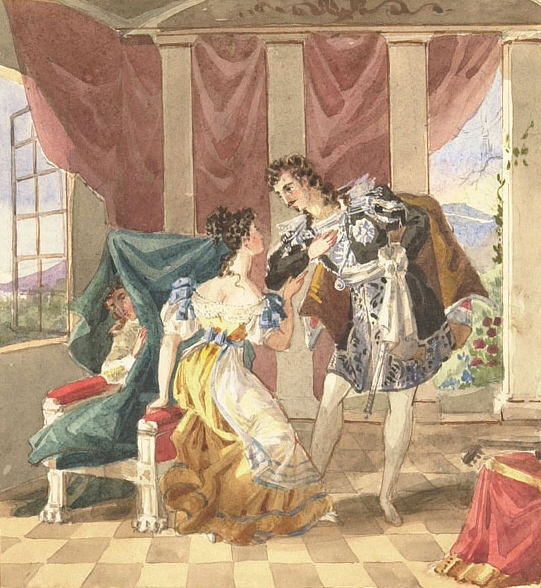
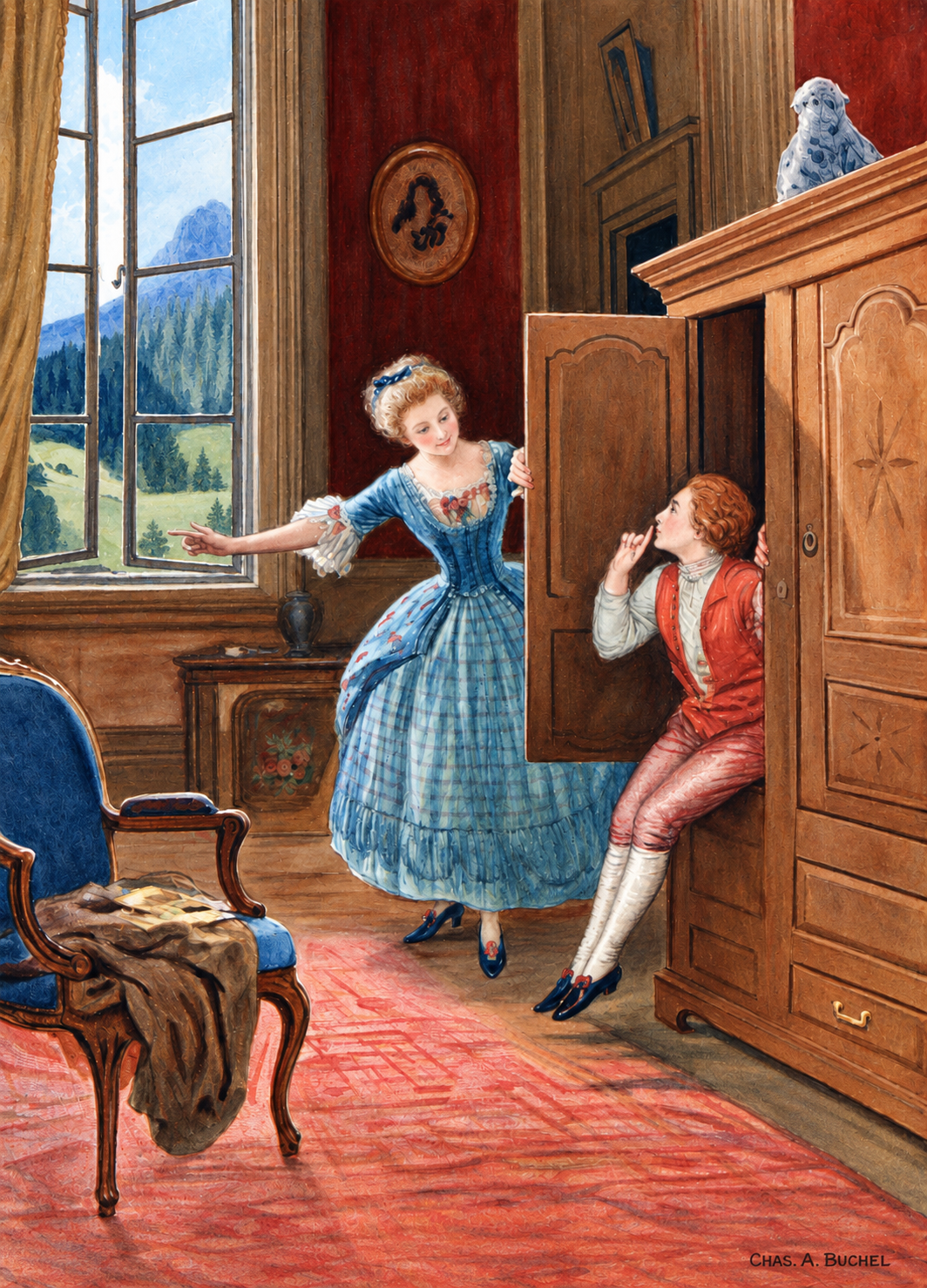
Printed Editions
| Year | Edition | Publisher | Buy |
|---|---|---|---|
| 2024 | Le nozze di Figaro / The Marriage of Figaro: Opera Libretto with Italian–English Translation | DM’s Opera Series |
|
Audio recordings
| Year | Cast | Conductor, Opera chorus and orchestra |
Label, Comment |
Buy |
|---|---|---|---|---|
| 1955
|
Figaro — Cesare Siepi Susanna — Hilde Gueden Count Almaviva — Alfred Poell Countess Almaviva — Lisa Della Casa Cherubino — Suzanne Danco Marcellina — Hilde Rössel-Majdan Bartolo — Frenando Dickie |
Erich Kleiber Vienna Philharmonic and Vienna State Opera Chorus |
CD: Decca Legends Cat: 466 369-2 Membran Cat: 222932-370 |

$40.99 |
| 1960 | Figaro — Giuseppe Taddei Susanna — Anna Moffo Count Almaviva — Eberhard Wächter Countess Almaviva — Elisabeth Schwarzkopf Cherubino — Fiorenza Cossotto |
Carlo Maria Giulini Philharmonia Orchestra |
CD: EMI Cat: 358602-2 |

$15.40 |
| 1968 | Figaro — Hermann Prey Susanna — Edith Mathis Count Almaviva — Dietrich Fischer-Dieskau Countess Almaviva — Gundula Janowitz Cherubino — Tatiana Troyanos Marcellina — Patricia Johnson Bartolo — Peter Lagger |
Karl Böhm Orchestra and Chorus of the Deutsche Oper Berlin |
CD: Deutsche Grammophon Cat: 449 728-2 |

$46.13 |
| 1981 | Figaro — Samuel Ramey Susanna — Lucia Popp Count Almaviva — Thomas Allen Countess Almaviva — Kiri Te Kanawa Cherubino — Frederica von Stade |
Sir Georg Solti London Philharmonic Orchestra and the London Opera Chorus |
CD: Decca Cat: 410 150-2 |

$8.42 |
| 1990 | Ferruccio Furlanetto Dawn Upshaw Thomas Hampson Kiri Te Kanawa Anne Sofie von Otter |
James Levine Metropolitan Opera Orchestra and Chorus |
CD: Deutsche Grammophon Cat: 477 5614 |

$43.23 |
| 1993 | Figaro — Bryn Terfel Susanna — Alison Hagley Count Almaviva — Rod Gilfry Countess Almaviva — Hillevi Martinpelto Cherubino — Pamela Helen Stephen Marcellina — Susan McCulloch Bartolo — Carlos Feller |
John Eliot Gardiner English Baroque Soloists and Monteverdi Choir |
DVD: Deutsche Grammophon Cat: 073 018-9 |

$10.94 |
| 2012 | Figaro — Christian Van Horn Susanna — Fanie Antonelou Count Almaviva — Andrei Bondarenko Countess Almaviva — Simone Kermes Cherubino — Mary-Ellen Nesi Marcellina — Maria Forsstrom |
Teodor Currentzis Perm Opera Orchestra and Chorus |
CD: SONY CLASSICAL Cat: 88883709262 |

$37.06 |

Books
| Year | Title | Description | Buy |
|---|---|---|---|
| 2024
|
Le nozze di Figaro / The Marriage of Figaro: Opera Libretto with Italian–English Translation | This edition of Le nozze di Figaro (The Marriage of Figaro) presents the complete Italian libretto by Lorenzo Da Ponte, set to music by Wolfgang Amadeus Mozart. The text appears in a side-by-side Italian–English format, ideal for students, performers, and opera lovers. |
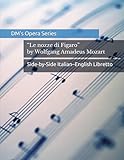
$14.99 |
Video recordings
| Year | Cast | Conductor, Opera chorus and orchestra, Director |
Label, Comment |
Buy |
|---|---|---|---|---|
| 1975 | Figaro — Hermann Prey Susanna — Mirella Freni Count Almaviva — Dietrich Fischer-Dieskau Countess Almaviva — Kiri Te Kanawa Cherubino — Maria Ewing |
Karl Böhm Vienna Philharmonic Orchestra Jean-Pierre Ponnelle |
DVD: Deutsche Grammophon Cat: DG 073 4034 |
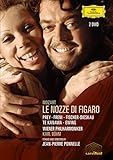
$33.30 |
| 2006 | Figaro — Ildebrando D'Arcangelo Susanna — Anna Netrebko Count Almaviva — Bo Skovhus Countess Almaviva — Dorothea Röschmann Cherubino — Christine Schäfer Marcellina — Marie McLaughlin |
Nikolaus Harnoncourt Vienna Philharmonic and Konzertvereinigung Wiener Staatsoper Brian Large |
Deutsche Grammophon Cat: DG 073 4245 |

$33.56 |
Related links
- Le nozze di Figaro: Italian–English Side-by-Side Libretto With Translation — LibrettoArchive Blog
- Wikipedia, the free encyclopedia
- Recordings on operadis-opera-discography.org.uk