“Otello” by Giuseppe Verdi
♡
Read Otello with the original libretto and a clear English translation presented side by side.
See on Amazon → 📄 Preview sample (PDF)Premiere / date of written: 5 February 1887
Otello is an opera in four acts by Giuseppe Verdi, with an Italian libretto by Arrigo Boito, based on William Shakespeare’s tragedy Othello. It was Verdi’s penultimate opera and premiered at the Teatro alla Scala in Milan on February 5, 1887.
Set in Cyprus in the late 15th century, the opera tells the tragic story of Otello, a celebrated Venetian general whose love for his wife, Desdemona, is destroyed by jealousy and the cunning manipulation of his ensign, Iago. Through powerful dramatic scenes and deeply expressive music, Verdi explores themes of love, betrayal, deception, and revenge.
Considered one of Verdi’s greatest masterpieces, Otello represents a remarkable achievement in his late career, combining continuous musical drama with extraordinary emotional intensity.
Libretti
Italian–English side-by-side translation
| # | Language | Authors |
|---|---|---|
| 1 |
Italian
  |
Arrigo Boito |
| 2 |
German
|
Gerd Uekermann |
| 3 |
English
|
|
| 4 |
French
|
J. Barnabé, 1986 |
original libretto
side-by-side of the original libretto
Notes on the Libretto
Arrigo Boito’s libretto for Verdi’s Otello is more than a condensation of Shakespeare’s tragedy. The Venetian opening of Othello disappears: the opera begins in Cyprus amid a violent storm, while the lovers’ earlier history emerges through their Act I duet. Iago’s Credo in un Dio crudel (“I believe in a cruel God”) is another significant departure. Rather than adapting an existing Shakespearean speech, Boito gives Iago a new declaration of his merciless philosophy.
In preparing the Italian–English side-by-side text, several small transcription and translation errors required attention. In Otello’s description of Desdemona’s handkerchief, lo stame arcano (“the mysterious thread”) had become Io stame arcano through a confusion between lowercase l and capital I. Elsewhere, Iago’s exclamation Ahi stolto! stolto! had been rendered as “Ah, stupidity! Stupidity!” The corrected “Ah, fool! Fool!” restores the personal insult directed at Roderigo.
A further editorial decision concerned character names. Boito’s Italian libretto uses Jago, while the English text uses Iago. The title character, however, is consistently called Otello in both columns, reserving Othello for Shakespeare’s play. This distinction preserves the conventions of each language without introducing unnecessary inconsistencies into the parallel text.
History
| February 24, 1842 | Birth of Arrigo Boito, librettist for Verdi's "Otello" and "Falstaff" and composer of "Mefistofele". |
| February 5, 1887 | World premiere (first performance) of Giuseppe Verdi’s opera "Otello" at Teatro alla Scala (Milan). |
| March 15, 1888 | Giuseppe Verdi’s "Otello" received its Austrian premiere at the Vienna Hofoper (today’s Wiener Staatsoper). |
| July 5, 1889 | Verdi's "Otello" received its first UK performance at the Lyceum Theatre, London. |
| October 17, 1955 | Verdi’s "Otello" received its Covent Garden Opera Company premiere at the Royal Opera House in London. |
Images
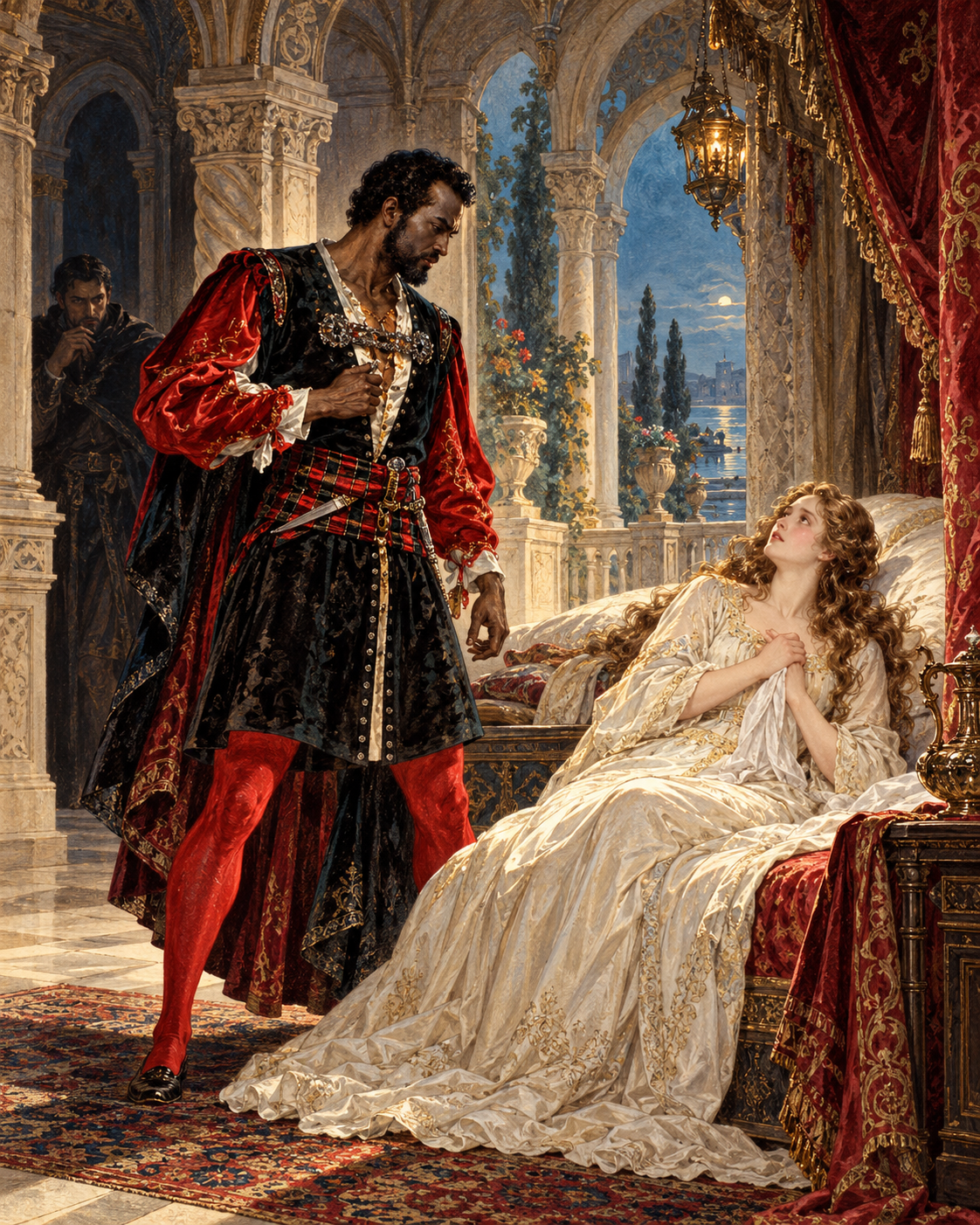
Printed Editions
| Year | Edition | Publisher | Buy |
|---|---|---|---|
| 2026 | Otello: Side-by-Side Italian–English Opera Libretto | DM’s Opera Series |
|
Audio recordings
| Year | Cast | Conductor, Opera chorus and orchestra |
Label, Comment |
Buy |
|---|---|---|---|---|
| 1932 | Otello — Nicola Fusati, Desdemona — Maria Carbone, Iago — Apollo Granforte, Cassio — Piero Girardi, Rodrigo — Nello Palai, Lodovico — Corrado Zambelli, Montano — Enrico Spada, Emilia — Tamara Beltacchi |
Carlo Sabajno La Scala Orchestra and Chorus, Milan |
CD: Preiser Records Cat: 20012 |

|
| 1947
|
Otello — Ramón Vinay, Desdemona — Herva Nelli, Iago — Giuseppe Valdengo, Cassio — Virginio Assandri, Rodrigo — Leslie Chabay, Lodovico — Nicola Moscona, Montano — Arthur Newman, Emilia — Nan Merriman |
Arturo Toscanini NBC Symphony Orchestra and chorus |
CD: RCA Victor Cat: 60302 |

$95.95 |
| 1954 | Otello — Mario Del Monaco, Desdemona — Renata Tebaldi, Iago — Aldo Protti, Cassio — Piero De Palma, Rodrigo — Angelo Mercuriali, Lodovico — Fernando Corena, Montano — Pier Luigi Latinucci, Emilia — Luisa Ribacchi, Un Araldo — Dario Caselli |
Alberto Erede Accademia Nazionale di Santa Cecilia orchestra and chorus |
CD: Decca |

|
| 1961 | Otello — Mario Del Monaco, Desdemona — Renata Tebaldi, Iago — Aldo Protti, Cassio — Nello Romanato, Rodrigo — Athos Cesarini, Lodovico — Fernando Corena, Montano — Tom Krause, Emilia — Ana Raquel Satra |
Herbert von Karajan Vienna Philharmonic Orchestra, Vienna State Opera Chorus |
CD: Decca Cat: 028941161826 |

$39.99 |
| 1973 | Otello — Jon Vickers, Desdemona — Mirella Freni, Iago — Peter Glossop, Cassio — Aldo Bottion, Rodrigo — Michel Sénéchal, Lodovico — José van Dam, Montano — Mario Macchi, Emilia — Stefania Malagù, Un Araldo — Mario Macchi |
Herbert von Karajan Berlin Philharmonic Orchestra, Berlin Deutsche Oper Chorus |
CD: EMI Cat: CMS 769 3082 |

$17.98 |
| 1978 | Otello — Plácido Domingo, Desdemona — Renata Scotto, Iago — Sherrill Milnes, Cassio — Frank Little Rodrigo — Paul Crook Lodovico — Paul Plishka Montano — Malcolm King Emilia — Jean Kraft Un Araldo — Malcolm King |
James Levine National Philharmonic Orchestra and Chorus |
CD: RCA Victor Cat: 74321395012 |

|
| 1992 | Otello — Plácido Domingo, Desdemona — Kiri Te Kanawa, Iago — Sergei Leiferkus, Cassio — Robin Leggate, Rodrigo — Ramon Remedios, Lodovico — Mark Beesley, Montano — Roderick Earle, Emilia — Claire Powell, Un Araldo — Christopher Lackner |
Sir Georg Solti Royal Opera House, Covent Garden Chorus and Orchestra Brian Large |
DVD:Kultur Video Cat: 0 32031 14929 8 |

$26.87 |
| 1994 | Otello — Plácido Domingo, Desdemona — Cheryl Studer, Iago — Sergei Leiferkus, Cassio — Ramón Vargas, Rodrigo — Michael Schade, Lodovico — Ildebrando d' Arcangelo, Montano — Giacomo Prestia, Emilia — Denyce Graves, Un Araldo — Philippe Duminy |
Myung-whun Chung Opéra Bastille, Paris |
CD: Deutsche Grammophon Cat: 439 805-2 |

$16.49 |
| 2013 | Otello — Aleksandrs Antonenko, Desdemona — Krassimira Stoyanova, Iago — Carlo Guelfi, Cassio — Juan Francisco Gatell, Rodrigo — Michael Spyres, Lodovico — Eric Owens, Montano — Paolo Battaglia, Emilia — Barbara Di Castri, Un Araldo — David Govertsen |
Riccardo Muti Chicago Symphony Orchestra and Chorus |
CSO Resound |

$26.40 |

Video recordings
| Year | Cast | Conductor, Opera chorus and orchestra, Director |
Label, Comment |
Buy |
|---|---|---|---|---|
| 1978 | Otello — Jon Vickers, Desdemona — Renata Scotto, Iago — Cornell MacNeil, Cassio — Raymond Gibbs, Rodrigo — Andrea Velis, Lodovico — James Morris, Montano — Robert Goodloe, Emilia — Jean Kraft, Un Araldo — Arthur Thompson |
James Levine Metropolitan Opera Orchestra and Chorus Franco Zeffirelli |
DVD: Met Opera Cat: 811357012185 Taken from the September 25, 1978 live performance. |

$6.79 |
| 1995 | Otello — Plácido Domingo, Desdemona — Renée Fleming, Iago — James Morris, Cassio — Richard Croft, Rodrigo — Charles Anthony, Lodovico — Alexander Anisimov, Montano — Ted Lambrinos, Emilia — Jane Bunnell, Un Araldo — Christopher Schaldenbrand |
James Levine Metropolitan Opera Orchestra and Chorus Brian Large |
DVD: Deutsche Grammophon Cat: 00440 073 0929 |

$29.03 |
Related links
- Otello: Italian–English Side-by-Side Libretto With Translation — LibrettoArchive Blog
- Wikipedia, the free encyclopedia
- Recordings on operadis-opera-discography.org.uk