“The Magic Flute” by Wolfgang Amadeus Mozart
♡
All 21 musical numbers and the complete original spoken dialogue.
See on Amazon – $14.99 → 📄 Preview sample (PDF)Premiere / date of written: 30 September 1791
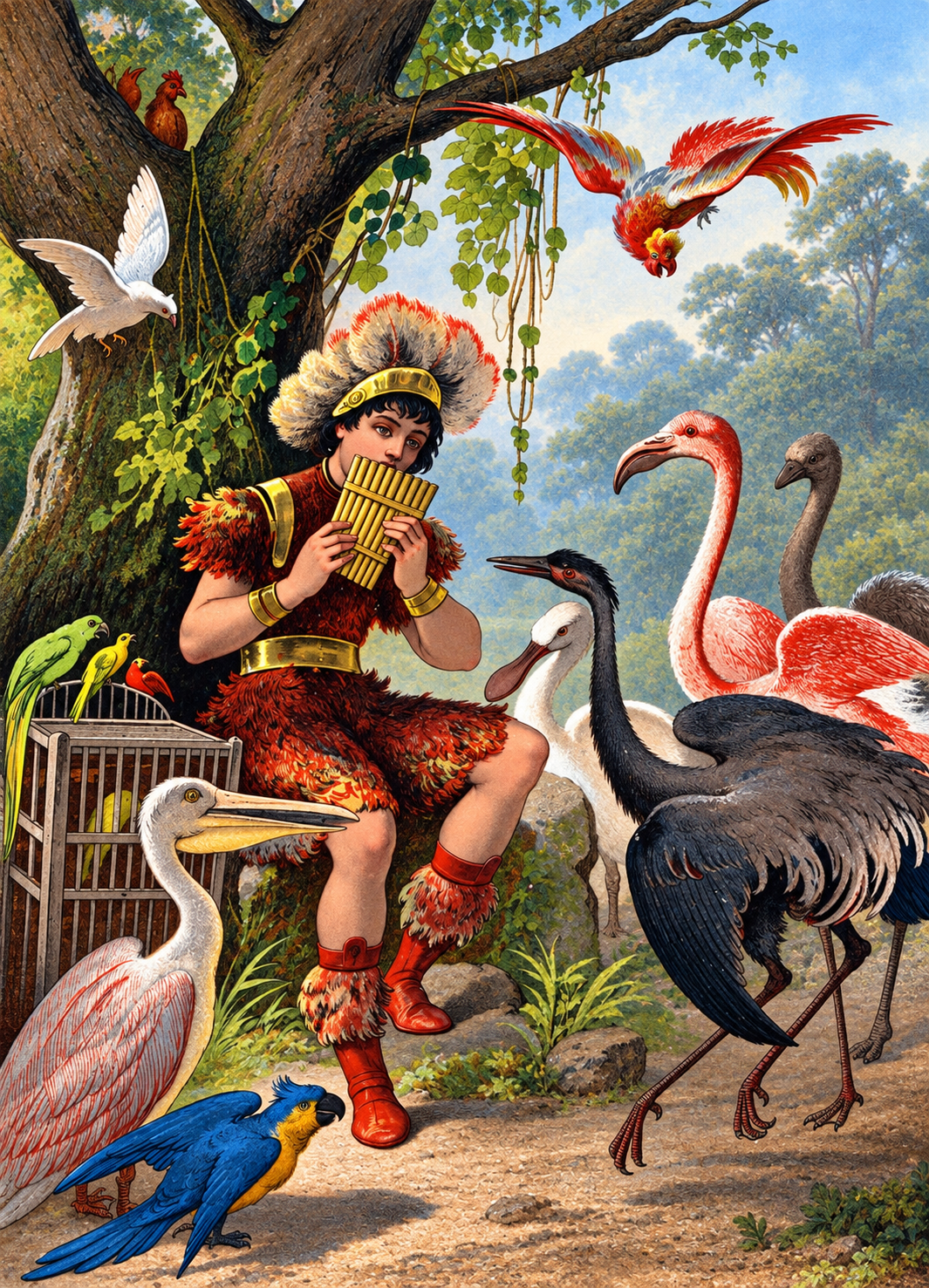
The Magic Flute (Die Zauberflöte) is a two-act opera by Wolfgang Amadeus Mozart with a German libretto by Emanuel Schikaneder. Combining fairy tale, comedy, and Enlightenment symbolism, it became one of Mozart’s final and most beloved works. The opera premiered in Vienna on 30 September 1791 at the Freihaus-Theater auf der Wieden. Mozart conducted the orchestra, Schikaneder performed Papageno, and the Queen of the Night was sung by Josepha Hofer, Mozart’s sister-in-law. Set in a fantastical Egypt-inspired world of temples, magic instruments, and secret brotherhoods, the opera follows Prince Tamino and Papageno on a journey of wisdom, love, and initiation. Beneath its comic and fairy-tale surface, the work reflects ideas associated with the Enlightenment and Freemasonry, including reason, truth, and moral purification. Musically, The Magic Flute ranges from simple folk-like songs to brilliant coloratura writing, including the Queen of the Night’s famous aria “Der Hölle Rache.” As a German Singspiel, the opera combines spoken dialogue with musical numbers, helping make it one of the most popular and frequently performed operas in the world.
Libretti
German–English side-by-side translation
| # | Language | Authors |
|---|---|---|
| 1 |
German
  |
Emanuel Schikaneder |
| 2 |
English
|
|
| 3 |
French
|
Arlette de Grouchy |
original libretto
side-by-side of the original libretto
Notes on the Libretto
Mozart’s Die Zauberflöte (1791), with a libretto by Emanuel Schikaneder, belongs to the German Singspiel tradition, in which spoken dialogue is as important to the drama as the musical numbers. Schikaneder himself created the role of Papageno, whose humor and personality emerge particularly clearly in the spoken scenes. In preparing the German–English text for LibrettoArchive, the abbreviated summaries previously used were replaced with the complete dialogue, including the Three Slaves’ account of Pamina’s attempted escape, which had been omitted entirely.
Several passages required comparison with historical sources. In Sarastro’s prayer, O Isis und Osiris, the line “Die ihr der Wand’rer Schritte lenket” addresses the gods directly: “You who guide the wanderers’ steps.” Its unusual genitive word order must be understood without introducing meanings absent from the German.
Other apparent irregularities proved to be authentic readings. In the quintet of Act II, the Three Ladies sing “Sie drang in Tempel heimlich ein,” while Papageno replies “Sie soll im Tempel sein?” Both forms occur in the original libretto and should not be indiscriminately standardised.
A further example appears in Pamina’s farewell to Tamino: “Mir flüstert Ahndung dieses ein.” The historical spelling Ahndung may be modernised to Ahnung, but the sense remains that of a dark premonition, rather than a passing doubt.
History
| September 30, 1791 | Wolfgang Amadeus Mozart's "Die Zauberflöte" received its world premiere at the Theater auf der Wieden in Vienna. |
| September 21, 1792 | Mozart's "Die Zauberflöte" received its earliest known performance outside Vienna in Lemberg, now Lviv, with further performances following on September 22 and 23. |
| March 30, 1900 | Mozart’s "Die Zauberflöte" was first performed at the Metropolitan Opera (New York), sung in Italian. |
| January 19, 1970 | Soprano Judith Blegen made her Metropolitan Opera debut as Papagena in Mozart’s "The Magic Flute." |
Images
Notable videos
|
Die Zauberflote | The Magic Flute | La Flauta Magica | l'Opera de Paris 2001
Cast: |
Printed Editions
| Year | Edition | Publisher | Buy |
|---|---|---|---|
| 2025 | The Magic Flute / Die Zauberflöte: Side-by-Side German–English Opera Libretto | DM’s Opera Series |
|
Audio recordings
| Year | Cast | Conductor, Opera chorus and orchestra |
Label, Comment |
Buy |
|---|---|---|---|---|
| 1964
|
Nicolai Gedda Gundula Janowitz Gottlob Frick Lucia Popp Walter Berry Ruth-Margret Pütz Cast also includes: Elisabeth Schwarzkopf Christa Ludwig |
Otto Klemperer Philharmonia Orchestra and Chorus |
EMI Great Recordings of the Century 5673852 |

$13.94 |

Related links
- The Magic Flute: German–English Side-by-Side Libretto With Translation — LibrettoArchive Blog
- The Magic Flute: German–English Side-by-Side Libretto With Translation — LibrettoArchive Blog
- Wikipedia, the free encyclopedia