| Wolfgang Amadeus Mozart operas |
|
• Die Entführung aus dem Serail (1782) • Le nozze di Figaro (1786) • Don Giovanni (1787) • Così fan tutte, ossia La scuola degli amanti (1790) • La clemenza di Tito (1791) • The Magic Flute (1791) |
“Così fan tutte, ossia La scuola degli amanti” by Wolfgang Amadeus Mozart
♡
Read Così fan tutte, ossia La scuola degli amanti with the original libretto and a clear English translation presented side by side.
See on Amazon – $13.99 → 📄 Preview sample (PDF)Premiere / date of written: 26 January 1790
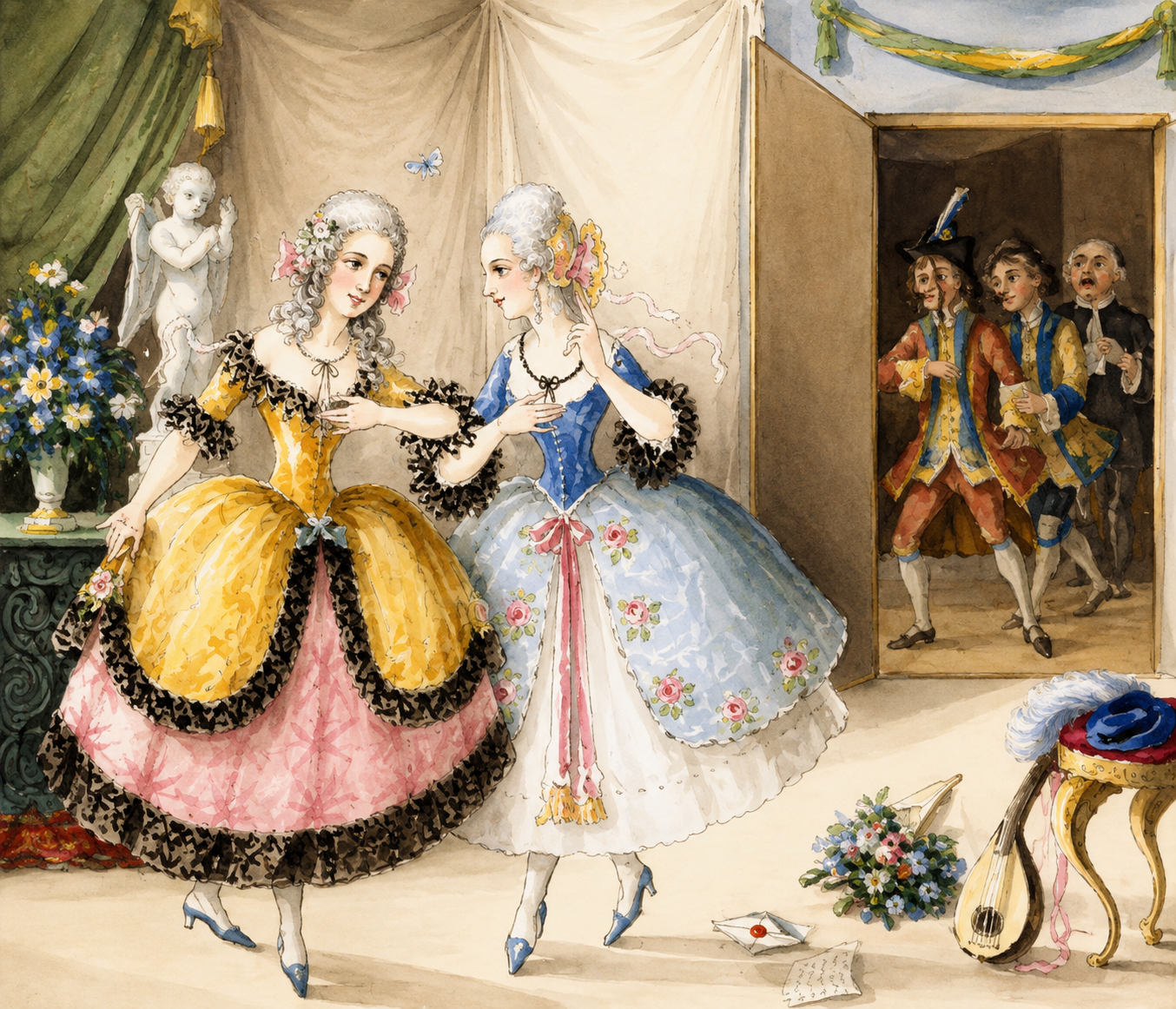
Così fan tutte, ossia La scuola degli amanti (Thus Do They All, or The School For Lovers) K. 588, is an Italian language opera buffa in two acts by Wolfgang Amadeus Mozart first performed in 1790. The libretto was written by Lorenzo Da Ponte. Così fan tutte is one of the three Mozart operas for which Da Ponte wrote the libretto. The other two Da Ponte-Mozart collaborations were Le nozze di Figaro and Don Giovanni.
Libretti
Italian–English side-by-side translation
| # | Language | Authors |
|---|---|---|
| 1 |
Italian
  |
Lorenzo Da Ponte |
| 2 |
German
|
|
| 3 |
English
|
|
| 4 |
French
|
B. Vierne |
original libretto
side-by-side of the original libretto
Notes on the Libretto
Preparing the Italian and English texts of Così fan tutte side by side brought to light a number of small discrepancies whose importance is easily missed in a freer translation. One occurs in Don Alfonso’s “ove il destino, anzi il dover v’invita.” The correction anzi is essential to the joke: he begins grandly with “destiny,” then substitutes the more prosaic “duty.” Rendering both words as “fate” effaces Da Ponte’s deliberate turn of thought.
Elsewhere the difficulty lies in preserving the particular color of the language. Despina’s “un’ottava” is not merely “a rhyme,” but an eight-line stanza; “d’altra pasta”, literally “of different dough,” describes women imagined as being made of different stuff. Such expressions resist word-for-word translation without either obscuring their sense or losing their comic character.
Comparison also revealed several modest but telling textual problems in the Italian. “Settantamille baci” was corrected to the proper settantamila, while the anomalous “Pártiti!” was normalized to “Partiti!” More consequential was the reading “se costei non ci/li ravvisa,” evidently preserving two alternatives in a working text. In context, ci gives the coherent reading: Ferrando and Guglielmo wonder whether the disguised men will be recognized—“if she does not recognize us.”
History
| April 30, 1789 | The premiere of Wolfgang Amadeus Mozart's opera "Così fan tutte" took place at the Burgtheater in Vienna. |
| January 26, 1790 | Wolfgang Amadeus Mozart’s opera "Così fan tutte" premiered at the Burgtheater in Vienna. |
| May 9, 1811 | "Così fan tutte" received its first performance at the King's Theatre, Haymarket, London. |
| March 24, 1922 | The U.S. premiere of Mozart’s "Così fan tutte" takes place at the Metropolitan Opera. |
Images
Printed Editions
| Year | Edition | Publisher | Buy |
|---|---|---|---|
| 2025 | Così fan tutte / The School for Lovers: Opera Libretto with Italian–English Translation | DM’s Opera Series |
|
Audio recordings
| Year | Cast | Conductor, Opera chorus and orchestra |
Label, Comment |
Buy |
|---|---|---|---|---|
| 1962 | Fiordiligi — Elisabeth Schwarzkopf, Dorabella — Christa Ludwig, Despina — Hanny Steffek, Ferrando — Alfredo Kraus, Guglielmo — Giuseppe Taddei, Alfonso — Walter Berry |
Karl Böhm Philharmonia Orchestra and Chorus |
CD: EMI Classics (re-issued 2000) |

$34.81 |
| 1973 | Fiordiligi — Pilar Lorengar, Dorabella — Teresa Berganza, Despina — Jane Berbié, Ferrando — Ryland Davies, Guglielmo — Tom Krause, Alfonso — Gabriel Bacquier |
Sir Georg Solti London Philharmonic Orchestra Chorus of the Royal Opera House |
CD: Decca |

$43.97 |
| 1974 | Fiordiligi — Montserrat Caballé, Dorabella — Janet Baker, Despina — Ileana CotrubaÈ™, Ferrando — Nicolai Gedda, Guglielmo — Wladimiro Ganzarolli, Alfonso — Richard Van Allan |
Sir Colin Davis Chorus and Orchestra of the Royal Opera House |
CD: Philips |

$13.06 |
Books
| Year | Title | Description | Buy |
|---|---|---|---|
| 2025
|
Così fan tutte / The School for Lovers: Opera Libretto with Italian–English Translation | This edition of Così fan tutte (The School for Lovers) presents the complete Italian libretto by Lorenzo Da Ponte, set to music by Wolfgang Amadeus Mozart. The text appears in a side-by-side Italian–English format, ideal for students, performers, and opera lovers. Enjoy this classic opera with the original Italian next to a clear and faithful English translation that preserves the wit and elegance of Da Ponte’s text |

$13.99 |

Video recordings
| Year | Cast | Conductor, Opera chorus and orchestra, Director |
Label, Comment |
Buy |
|---|---|---|---|---|
| 2006 | Fiordiligi — Miah Persson, Dorabella — Anke Vondung, Despina — Ainhoa Garmendia, Ferrando — Topi Lehtipuu, Guglielmo — Luca Pisaroni, Alfonso — Nicolas Rivenq |
Iván Fischer Orchestra of the Age of Enlightenment, The Glyndebourne Chorus, London Sir Nicholas Hytner |
DVD: Opus Arte Cat: OA 0970 D OCLC 137342087 |

$56.30 |
Related links
- Così fan tutte: Italian–English Side-by-Side Libretto With Translation — LibrettoArchive Blog
- Wikipedia, the free encyclopedia