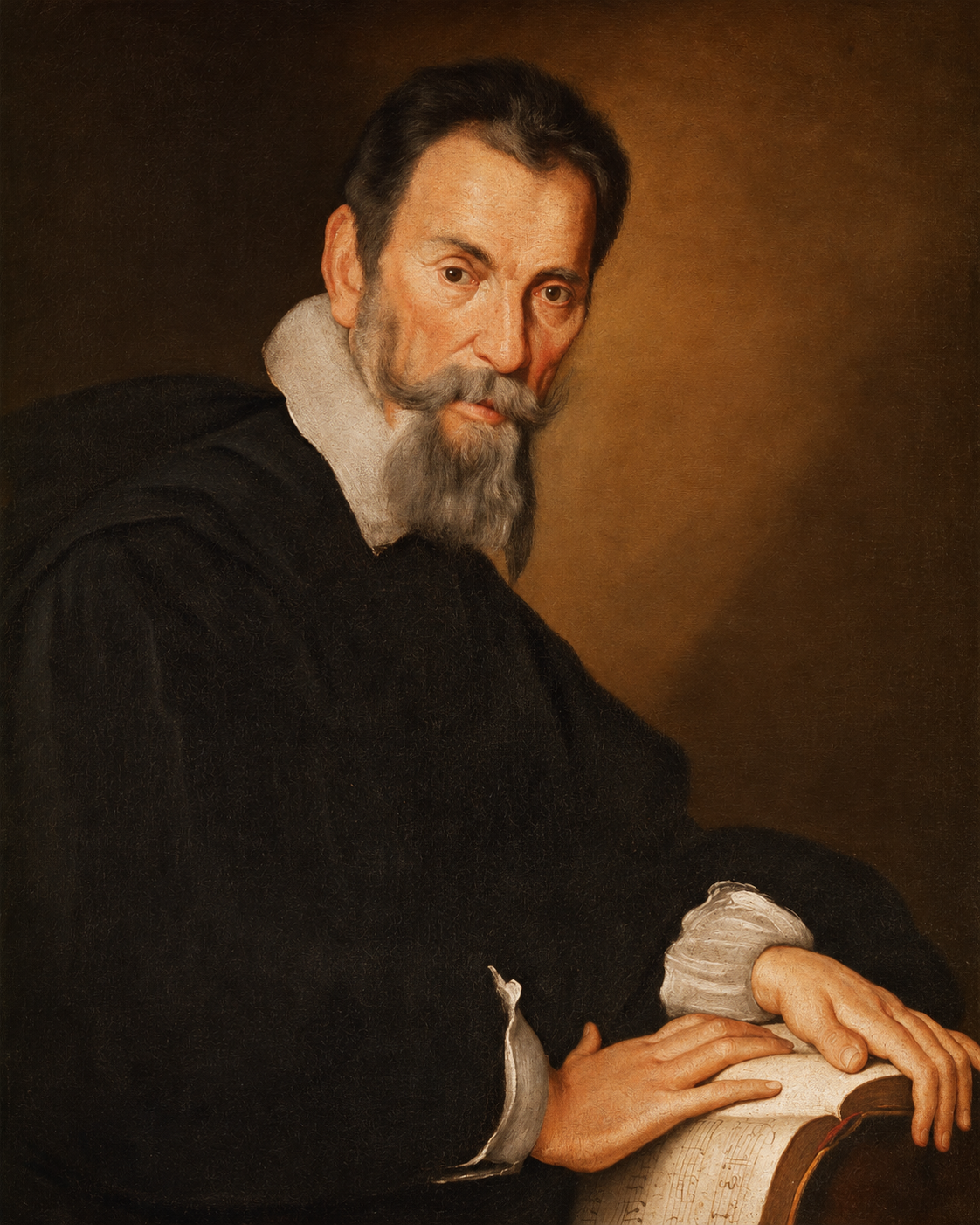
Claudio Monteverdi
Claudio Monteverdi was an Italian composer whose work helped shape the transition from Renaissance music to the Baroque era. He is regarded as one of the most important figures in the early history of opera, transforming a relatively new form of musical entertainment into a powerful means of dramatic expression.
Born in Cremona in 1567, Monteverdi received his early musical training under Marc'Antonio Ingegneri, maestro di cappella at Cremona Cathedral. Around 1590, he entered the service of the Gonzaga court in Mantua, where he developed his reputation as a composer of madrigals and theatrical music. In 1613, he became maestro di cappella at St. Mark's Basilica in Venice, a prestigious position he held until his death in 1643.
Monteverdi believed that music should express the emotions and meaning of the words it accompanied. His approach, associated with the seconda pratica, allowed composers greater freedom in the use of harmony and dissonance to convey human passions. These principles became fundamental to the development of opera.
His L'Orfeo (1607), based on the Greek myth of Orpheus and Eurydice, is one of the earliest surviving operas and a landmark in musical history. Monteverdi combined expressive solo singing, choruses, instrumental passages, and dramatic orchestration to create a remarkably unified theatrical work. His next opera, L'Arianna (1608), was enormously admired in its time, although only its celebrated lament survives in substantial form.
Later in life, Monteverdi contributed to the development of public opera in Venice. His surviving late operas, Il ritorno d'Ulisse in patria (1640) and L'incoronazione di Poppea (1643), demonstrate an extraordinary understanding of human character. Their music portrays love, ambition, jealousy, grief, and political intrigue with a psychological depth that remains compelling today.
Beyond opera, Monteverdi composed influential collections of madrigals and sacred music, including the Vespro della Beata Vergine (1610), commonly known as the Vespers of 1610.
Monteverdi did not invent opera, but he played a decisive role in establishing its artistic possibilities. More than four centuries later, his works remain part of the operatic repertoire, admired for their emotional directness, dramatic intensity, and remarkable ability to bring human stories to life through music.
Operas
| Opera | Premiere or date of written | Libretti available |
|---|---|---|
L'Orfeo  |
1607, February 24 | |
| Il ritorno d'Ulisse in patria | 1640 | |
| L'incoronazione di Poppea | 1643 |